

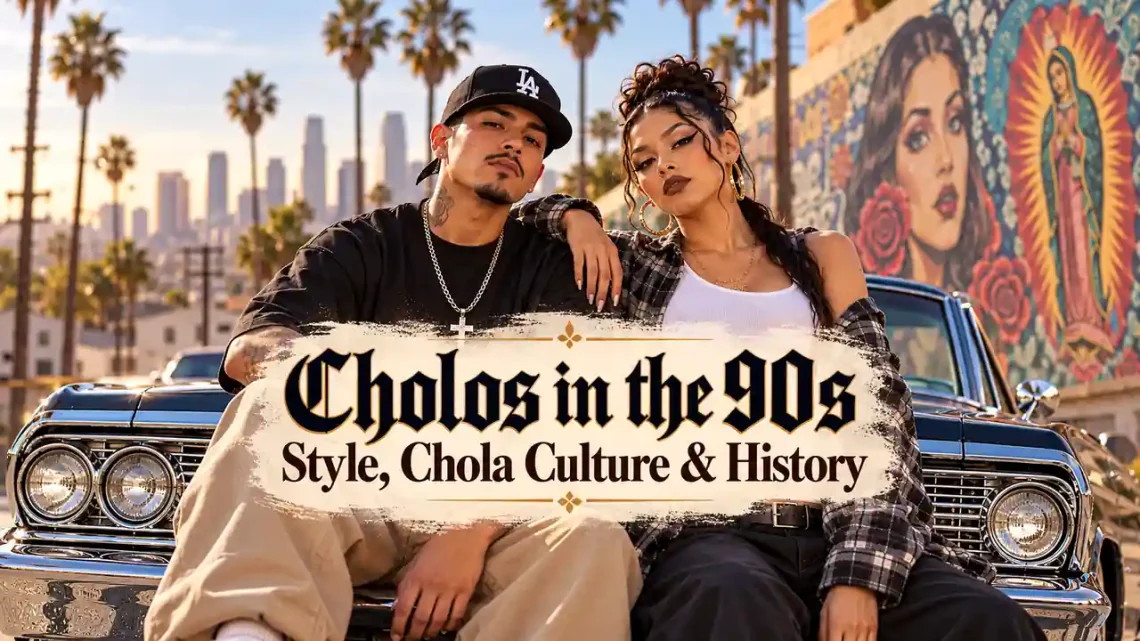
Cholos in the 90s became one of the most recognizable expressions of Southern California Mexican American street culture, but the identity and visual language did not begin in that decade. The 1990s amplified older barrio traditions through fashion, beauty, lowriders, music, film, tattooing, and neighborhood life. Oversized workwear, sharply styled hair, dark-lined lips, hoop earrings, custom cars, and lettering became especially visible in popular culture, but these elements carried meanings that were far more complex than a single “gangster” look.
Quick Answer: Cholos in the 90s were associated with a distinctive Southern California barrio style that could include oversized khakis or jeans, white tees, flannels, workwear, sneakers, slicked or teased hair, hoop earrings, nameplate jewelry, dark lip liner, tattoos, and lowrider culture. Cholo and Chola identity, however, was not simply a fashion trend and was not interchangeable with being Mexican American, Chicano, or a gang member. Its meaning varied by neighborhood, gender, generation, and personal identity.
What Did Cholo and Chola Mean in the 1990s?
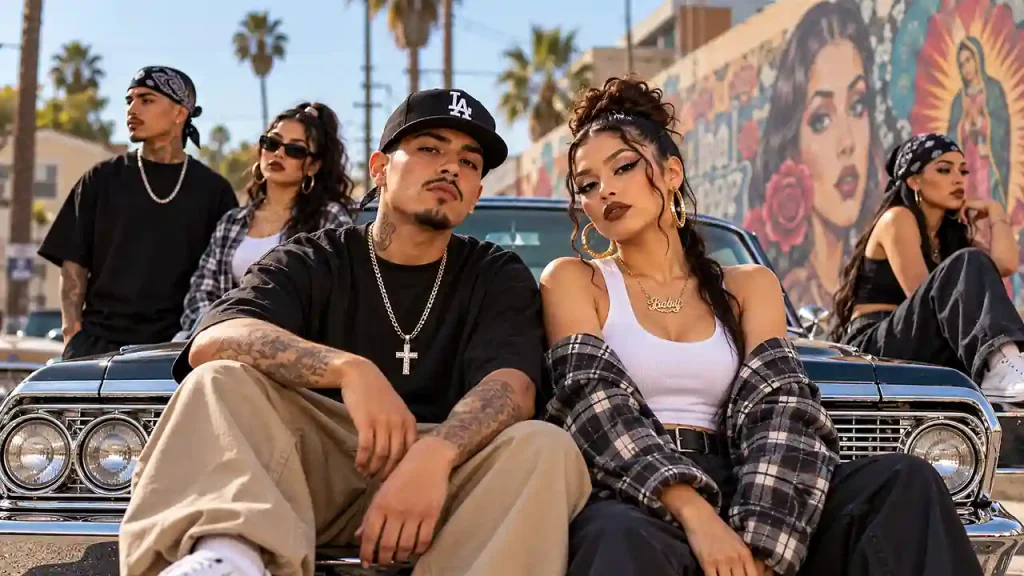
In the Southern California context, “cholo” and “chola” have been used for Mexican American urban and barrio identities associated with recognizable forms of dress, language, street art, tattoos, lowriding, music, and neighborhood culture. In some settings, the terms also carried gang associations, which contributed to outside stigma and stereotyping.
The distinction matters. Chicano is a much broader cultural and political identity, and not every Mexican American identifies as Chicano. Likewise, not every Chicano identified as a cholo, and someone wearing baggy workwear or dark lip liner was not automatically part of a gang. Treating these identities as synonyms erases the variety within Mexican American communities. The Smithsonian likewise describes cholo/a in relation to Mexican American urban street culture while treating Chicano as a broader cultural identity.
Cholos in the 90s at a Glance
| Element | Common 1990s Associations |
| Clothing | Oversized jeans, khakis, work pants, white tees, tanks, flannels |
| Makeup | Thin brows, black eyeliner, dark lip liner, high-contrast lips |
| Hair | Slicked styles, teased bangs, styled baby hairs, ponytails, braids |
| Accessories | Hoop earrings, nameplates, sunglasses, bandanas, gold-tone jewelry |
| Visual culture | Tattoos, lettering, murals, graffiti, lowrider art |
| Music and media | West Coast rap, oldies, films, music videos |
| Geography | Especially Southern California and the U.S. Southwest |
These were common associations rather than a uniform dress code. Style changed from one neighborhood, family, generation, and individual to another.
Before the 90s: Pachucos, Pachucas and Chicano Identity
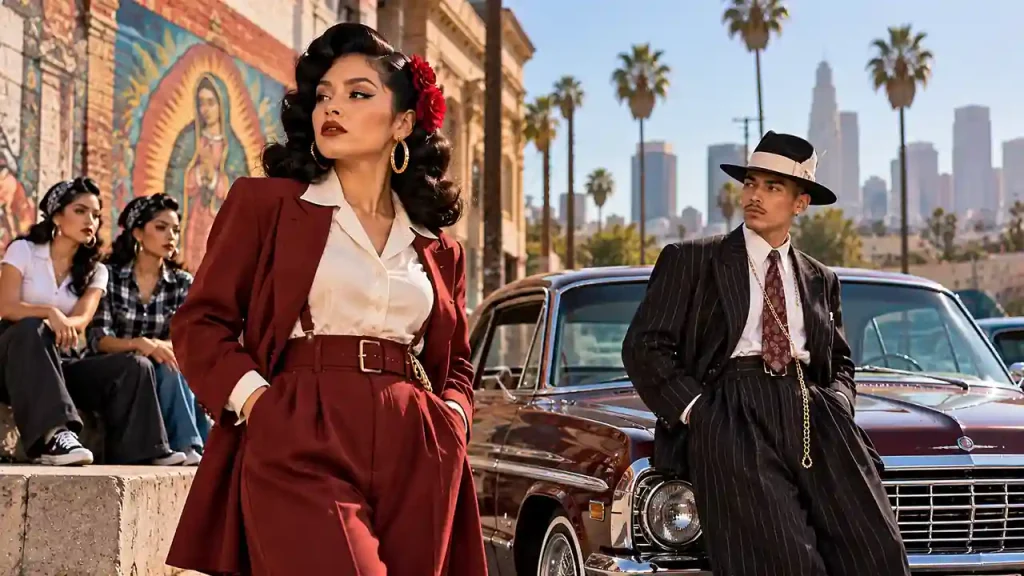
The story begins well before the 1990s. In the 1940s, pachucos and pachucas became highly visible Mexican American youth figures in Los Angeles and other Southwestern communities. The Smithsonian’s history of Pachuca fashion and identity explains how Pachuca style challenged expectations around gender, citizenship, and respectable femininity. Pachucas could wear zoot-suit-inspired clothing and other deliberately striking styles, while historical sources also document distinctive hairstyles and makeup. Pachuca culture was not the same thing as later Chola culture, but it helps explain a longer tradition of Mexican American youth using clothing, hair, beauty, and attitude to communicate identity in public.
The Chicano Movement developed later, especially during the 1960s and 1970s, around political empowerment, civil rights, equality, labor, education, and cultural pride. Smithsonian material on the Chicano Movement and lowrider artistic culture documents those connections while also distinguishing Chicano political identity from cholo/a street identity. Cholo culture therefore did not “create” the Chicano Movement, and the two should not be treated as interchangeable. By the time cholos in the 90s became widely recognizable through music, film, fashion, and street imagery, decades of Mexican American political, artistic, automotive, and youth history had already shaped the cultural landscape.
What Cholos and Cholas Wore in the 90s
1. Chola Makeup
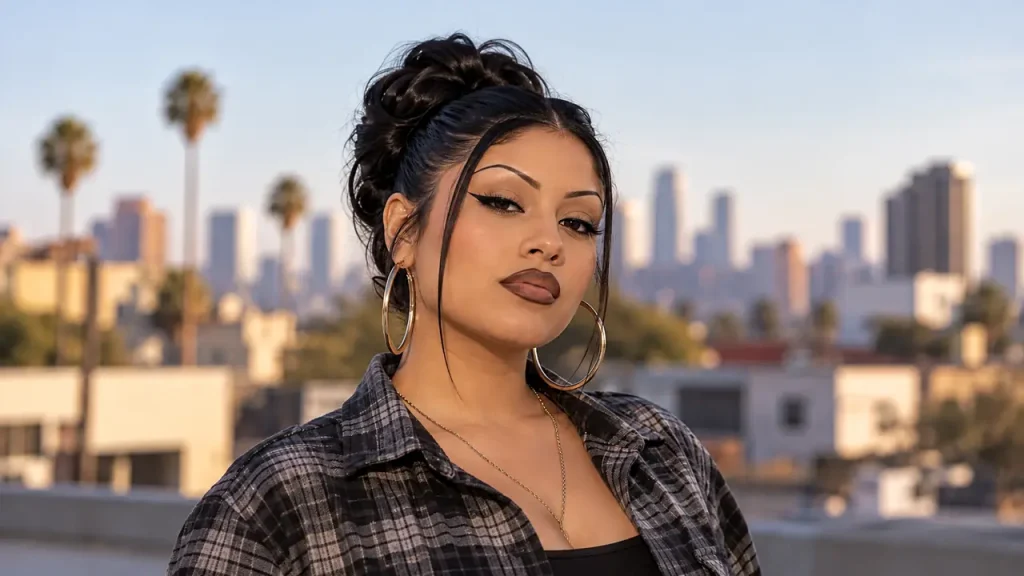
One of the most recognizable visual signatures of the period was Chola makeup: thin or sharply arched brows, crisp black eyeliner, dark brown, burgundy, or plum lip liner, and a lighter or contrasting lip center. Styled hair and large hoop earrings often completed the look. The history behind Chola makeup and its cultural meaning is more useful than describing it simply as “tough girl” beauty. Its visual language developed within Mexican American and Chicana communities while also intersecting with broader 1990s cosmetics. Thin brows, brown lip tones, matte complexions, and strongly defined eyes were also visible across mainstream beauty, and looking at makeup through the decades helps place those features within the wider beauty history of the 1990s.
Fake teardrop tattoos should not be treated as a standard Chola beauty feature. Such markings can have very different personal, prison, gang, memorial, or artistic meanings depending on context. Using them simply as shorthand for “looking Chola” reduces a complex cultural identity to a stereotype.
2. Clothing and Workwear
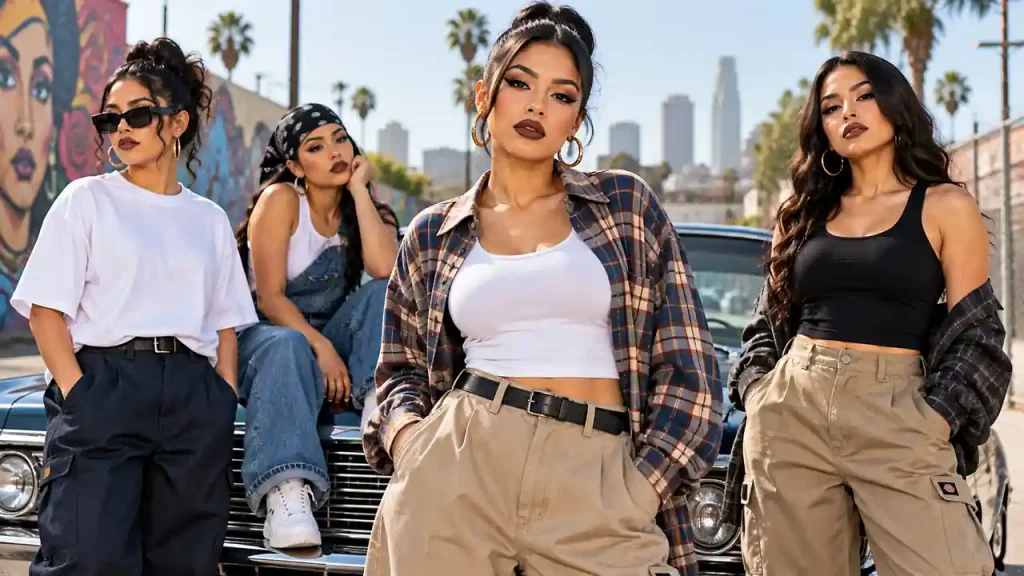
Common looks included oversized khakis or jeans, Dickies-style work pants, crisp white tees, tank tops, plaid or flannel shirts, overalls, shorts, and sneakers. Shirts might be worn oversized or buttoned near the collar, while Cholas could combine looser workwear with fitted tops, hoops, sunglasses, or carefully styled hair. The clothes were not automatically gang uniforms. Workwear was practical, durable, and affordable, and similar silhouettes moved through Chicano street culture, Black West Coast hip-hop, skate style, and other urban scenes. These overlapping influences are one reason it is misleading to assign every baggy pair of pants, flannel, or bandana to a single community.
3. Hairstyles
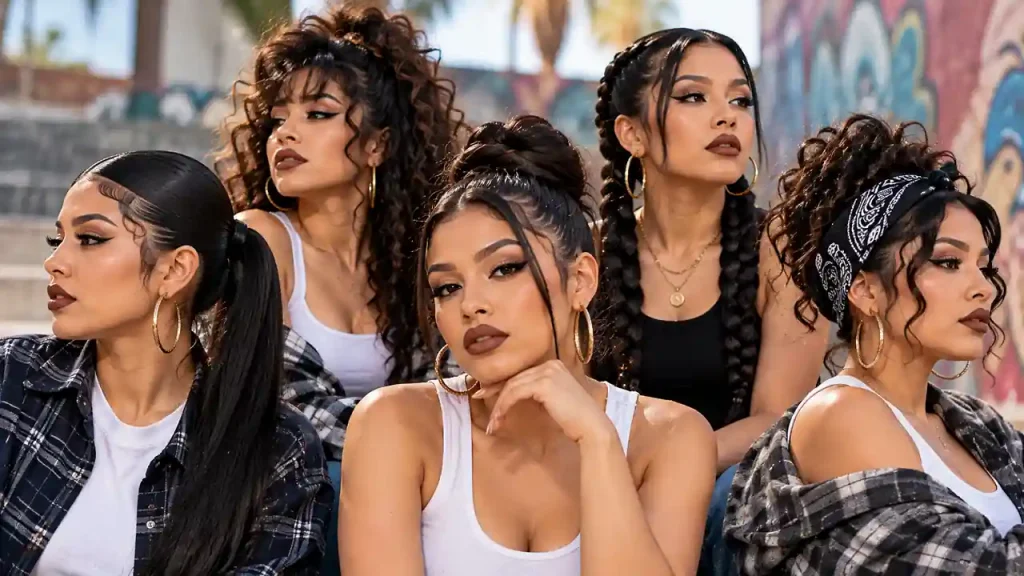
Chola hairstyles could include slicked-back hair, sculpted baby hairs, teased or elevated bangs, ponytails, curls, braids, center parts, and bandanas. Some styles created height and drama around the forehead, while others emphasized clean, controlled lines around the face. Like clothing, there was no single mandatory hairstyle. Grooming choices changed according to age, neighborhood, occasion, and personal taste.
4. Jewelry and Accessories
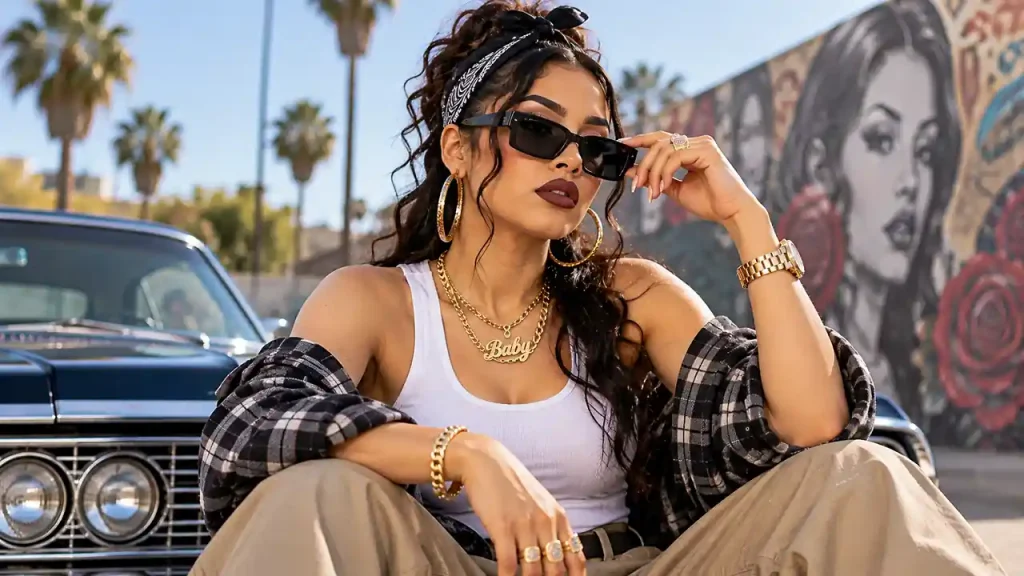
Large hoop earrings, nameplate necklaces, rings, bracelets, dark sunglasses, and gold-tone jewelry became recognizable components of many Chola looks. Cholos might also wear chains, rings, watches, or other statement pieces. These accessories later became highly visible in fashion and music imagery, but they are better understood as parts of a wider cultural vocabulary rather than a checklist determining who was or was not a Cholo or Chola.
5. Tattoos, Lettering, and Lowrider Culture
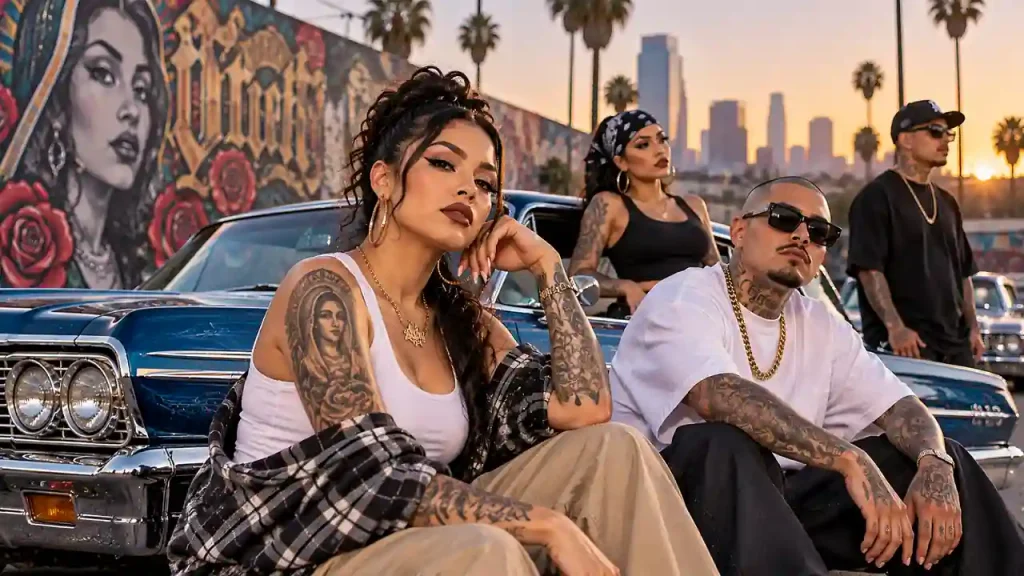
Tattooing and lettering became important visual languages in some Chicano and Cholo communities. Family names, memorials, religious imagery, neighborhood references, script lettering, portraits, and other designs could carry personal or community meaning. Their significance was never universal, so tattoos should not automatically be interpreted as signs of criminality or defiance.
Lowrider culture is equally important to understanding the era. Mexican American communities had been customizing cars since the postwar period, and lowriding developed into a tradition centered on craftsmanship, cruising, family, community, car clubs, detailed paintwork, hydraulics, pinstriping, and visual storytelling. The Smithsonian’s current Corazón y vida: Lowriding Culture exhibition traces this tradition across roughly eight decades and describes lowriding as an expression of Chicano pride, artistry, family, and community. For Cholos in the 90s, lowrider imagery helped create a broader visual world that included cars, music, murals, lettering, neighborhood spaces, clothing, and social gatherings. Looking only at makeup or baggy clothes misses much of that cultural context.
Cholos in 90s Music, Film, and Pop Culture
The 1990s brought Cholo and Chola imagery to larger audiences. West Coast rap videos, films, lowrider magazines, fashion photography, and television made visual elements associated with barrio and lowrider culture increasingly recognizable outside Southern California. Smithsonian material on lowriders also notes their prominent role in 1990s West Coast hip-hop videos. That visibility came through cultural exchange rather than one-way influence. Chicano street style, Black West Coast hip-hop, skate culture, workwear, and lowrider imagery often overlapped. A bandana, oversized shirt, or pair of khakis, therefore, should not automatically be labeled “Cholo” every time it appears in a music video.
Film played an especially important role. Mi Vida Loca, American Me, and Blood In, Blood Out are among the Cholo and Chicano movies that brought different portrayals of barrio life, friendship, family, lowriding, identity, violence, and community conflict to wider audiences. They are dramatizations rather than documentaries, but they helped shape popular perceptions of Chicano and Cholo life. For cholos in the 90s, mainstream exposure was a double-edged sword: it spread cultural influence while also reinforcing stereotypes that reduced complex communities to gangs, violence, or a handful of recognizable visual markers.
How the Aesthetic Traveled Beyond Southern California
Lowrider and Chicano visual culture eventually traveled far beyond the neighborhoods where many of its best-known forms developed. Customized cars, tattoos, lettering, music, clothing, and visual art have been reinterpreted elsewhere in the United States and internationally. Smithsonian research describes lowriding as an intergenerational Mexican American cultural tradition that has expanded nationally and globally.
That wider reach does not mean Cholo identity has one universal global meaning. It is more accurate to describe these scenes as adaptations of Mexican American, Chicano, and Southern California lowrider influences that acquire new meanings in different local settings.
Chola Style: Appreciation vs Caricature
Many individual elements associated with Chola style—hoop earrings, winged eyeliner, brown lip liner, slicked hair, flannels, or workwear—are not owned exclusively by one community. Cultural problems arise when an entire identity is turned into a costume.
Fake gang tattoos, exaggerated accents, stereotyped “gangster” behavior, or Halloween caricatures can erase the history of people who were stigmatized for styles that fashion and beauty industries later celebrated. Appreciation begins with context: recognize Mexican American and Chicana influences, avoid treating gang stereotypes as universal, and understand that the same visual element may carry very different meanings depending on who wears it and why.
Final Thoughts
Cholos in the 90s left a lasting mark on fashion, beauty, music, film, tattoo art, and lowrider culture, but their history is much larger than baggy khakis, dark lip liner, hoop earrings, or a single street stereotype. The decade increased the visibility of traditions shaped by earlier Mexican American youth culture, Chicano history, barrio life, lowriding, and cultural exchange. Understanding that background makes the style more interesting while helping separate living cultural history from the caricatures that have too often defined it.


Leave a Reply