

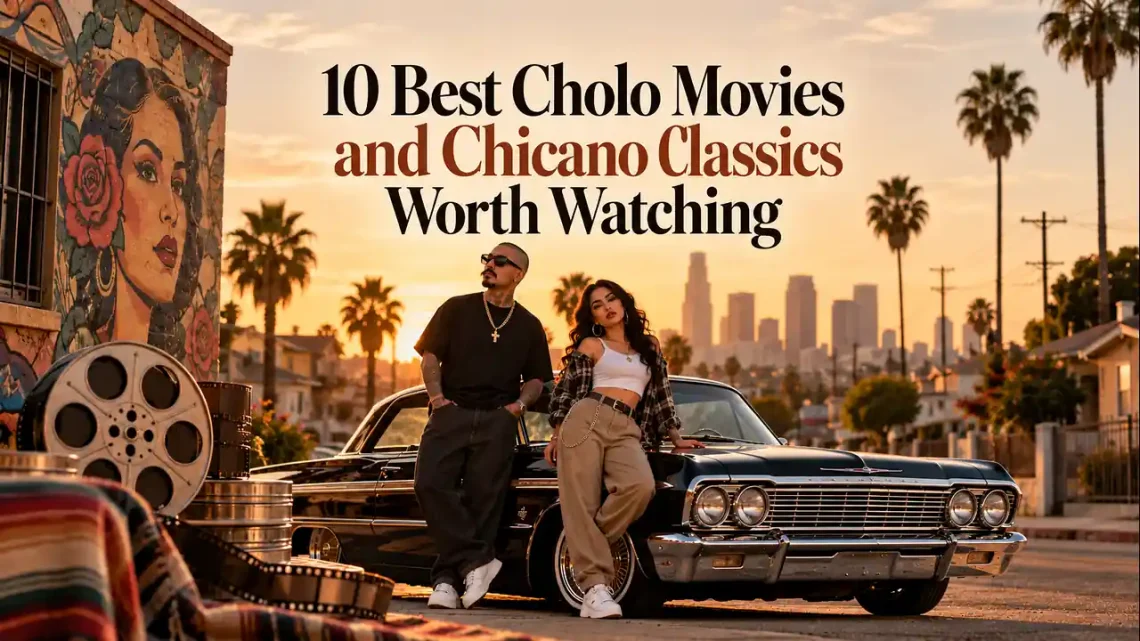
The best Cholo movies do more than show gang conflict, lowriders, or street style. At their strongest, they explore Mexican-American identity, barrio life, family loyalty, discrimination, migration, music, education, and the pressure of moving between cultures. Films such as Mi Vida Loca, American Me, Blood In Blood Out, and Boulevard Nights are closely tied to cholo or barrio representation, while movies such as Zoot Suit, La Bamba, and Stand and Deliver belong to the broader tradition of Chicano cinema. Together, they show why Mexican-American stories cannot be reduced to one image or stereotype.
Quick Answer: If you are looking for Cholo movies, start with Mi Vida Loca, American Me, Blood In Blood Out, Boulevard Nights, and Walk Proud. For a broader view of Chicano cinema, add Zoot Suit, Born in East L.A., La Bamba, Selena, and Stand and Deliver. Some center barrio or gang life; others explore music, education, immigration, racial injustice, family, and bicultural identity.
What Makes a Movie a “Cholo Movie”?
“Cholo movie” is an informal label rather than a formal film genre. It is commonly used for films connected to Mexican-American barrio life, Southern California street culture, lowriders, gang identity, pachuco or cholo aesthetics, and questions of belonging, loyalty, discrimination, and survival.
But Cholo movies and Chicano films are not interchangeable categories. Chicano cinema is much broader. The Library of Congress guide to Latinx representation in film documents a long history in which Latino voices were underrepresented while Latino characters were often presented through reductive stereotypes. That makes context especially important when watching older films about barrios, gangs, and Mexican-American communities. If you want more background on the subculture itself, our guide to cholo culture in the 90s explores its style, identity, and cultural context.
How We Chose These Films
This list is not based on changing audience scores. We prioritized cultural relevance, connection to cholo, pachuco, barrio, or broader Chicano experience, historical significance, and lasting recognition. We also deliberately included several films that move beyond gang narratives so the list does not imply that Chicano cinema—or Mexican-American life—is defined by crime.
10 Cholo and Chicano Movies to Add to Your Watchlist
1. Mi Vida Loca (1993)
Director: Allison Anders
Genre: Crime, Drama
Set around Echo Park in Los Angeles, Mi Vida Loca stands apart because young Chicana women occupy the center of the story rather than the background of a male gang narrative. Friendship, motherhood, romance, neighborhood loyalty, grief, and violence collide as the women navigate barrio life. Its visual language—dark lip liner, thin brows, hoops, tattoos, and lowrider imagery—is equally memorable. Our history of chola style and makeup gives useful context for those aesthetics.
Why it matters: It gives cholas agency and interior lives in a film culture that has often centered men.
2. American Me (1992)
Director: Edward James Olmos
Genre: Crime, Drama
Edward James Olmos directs and stars in this bleak drama about Montoya Santana, whose life is shaped by juvenile detention, prison, gang power, and violence. Moving between East Los Angeles and California’s prison system, the film examines loyalty, institutionalization, masculinity, and cycles of violence. It should not be treated as a portrait of Chicano culture as a whole. Instead, it depicts one harsh strand of Mexican-American gang and prison experience.
Why it matters: Few mainstream films of its era approached Chicano incarceration and gang identity with comparable seriousness.
3. Blood In Blood Out (1993)
Director: Taylor Hackford
Genre: Crime, Drama
Also known as Bound by Honor, the film follows Miklo, Paco, and Cruz, three relatives whose lives diverge through gang membership, law enforcement, art, addiction, and prison. Its emotional center is family: what relatives owe one another, how loyalty changes under pressure, and whether people can escape choices that reshape an entire household. That makes it especially interesting alongside our discussion of family dynamics.
Why it matters: Its scale, East L.A. setting, memorable characters, and themes of belonging have given it lasting cult status.
4. Boulevard Nights (1979)
Director: Michael Pressman
Genre: Crime, Drama
Boulevard Nights follows brothers Raymond and Chuco Avila in East Los Angeles. Raymond is trying to build a stable adult life, while Chuco remains more deeply entangled in gang conflict. The movie combines lowrider culture, family tension, neighborhood identity, and street violence. Like many films about marginalized communities made by mainstream Hollywood, it can also be watched critically for the assumptions and stereotypes of its period.
Why it matters: It is one of the early mainstream features most closely associated with Chicano barrio and lowrider cinema.
5. Walk Proud (1979)
Director: Robert Collins
Genre: Drama
Walk Proud centers on Emilio Mendez, a teenager involved with a Mexican-American street gang in Los Angeles who begins questioning whether he wants the life expected of him. The film is worth watching partly because of its limitations. Its production researched Chicano gangs, but the movie also became part of a broader debate about authenticity, casting, and how Hollywood represents Mexican-American communities.
Why it matters: It offers an early example of the tension between representing cholo life and turning that life into a simplified gang story.
6. Zoot Suit (1981)
Director: Luis Valdez
Genre: Drama, Musical
Adapted from Luis Valdez’s stage play, Zoot Suit dramatizes the Sleepy Lagoon case and the racial climate surrounding Mexican-American youth in 1940s Los Angeles. Edward James Olmos plays El Pachuco, a charismatic figure who functions as narrator, conscience, and cultural symbol. The film’s theatrical structure makes it unlike anything else on this list. Music, history, stylization, and political commentary sit side by side.
The Library of Congress National Film Registry includes Zoot Suit among films recognized for their cultural, historical, or aesthetic significance.
Why it matters: It connects pachuco identity to a deeper history of racism, cultural pride, resistance, and Chicano self-definition.
7. Born in East L.A. (1987)
Director: Cheech Marin
Genre: Comedy
Cheech Marin turns immigration and identity into satire in Born in East L.A. He plays Rudy Robles, a U.S.-born Mexican American who is mistakenly deported to Mexico and has to find his way home. Beneath the comedy are serious questions: Who is assumed to belong in America? How much do language and appearance shape those assumptions? What happens when someone is treated as foreign in his own country?
Why it matters: It broadens the watchlist beyond gang narratives while remaining rooted in East L.A. and Mexican-American identity.
8. La Bamba (1987)
Director: Luis Valdez
Genre: Biography, Drama, Music
La Bamba tells the story of Ritchie Valens, the teenage Mexican-American musician whose rapid rise in early rock ‘n’ roll ended with his death in a 1959 plane crash. Lou Diamond Phillips brings energy and vulnerability to Valens, while the film explores ambition, family tension, cultural identity, and the pressures surrounding a Mexican-American performer in the 1950s.
The film entered the National Film Registry in 2017.
Why it matters: It expands Chicano cinema beyond barrio crime stories and preserves the story of a major Mexican-American figure in American popular music.
9. Selena (1997)
Director: Gregory Nava
Genre: Biography, Drama, Music
Jennifer Lopez stars as Selena Quintanilla-Pérez, the Texas-born Tejano star who became an enduring Mexican-American cultural icon. The film follows Selena’s family, marriage to Chris Pérez, career, and crossover ambitions while capturing the experience of moving between Mexican and American cultural expectations. Its warmth and family-centered storytelling gives this list a necessary change of tone.
Why it matters: Selena represents another dimension of Mexican-American life: music, entrepreneurship, language, family, ambition, and bicultural identity.
10. Stand and Deliver (1988)
Director: Ramón Menéndez
Genre: Biography, Drama
Edward James Olmos plays teacher Jaime Escalante, who challenges students at Garfield High School in East Los Angeles to master advanced mathematics despite low expectations placed on them. Rather than presenting East L.A. primarily through crime, the film focuses on education, discipline, institutional expectations, and student potential. It is also included in the National Film Registry.
Why it matters: It directly challenges the idea that stories about Chicano communities must revolve around gangs or violence.
Why Chicano Cinema Matters Beyond Gang Stories
A strong list of Cholo movies should acknowledge the cultural importance of barrio-centered films without allowing gang imagery to become shorthand for an entire community.
That is why this watchlist moves from American Me and Blood In Blood Out to La Bamba, Selena, Born in East L.A., and Stand and Deliver. Together, these films address incarceration, sisterhood, family loyalty, immigration, education, music, racism, ambition, bicultural identity, and cultural pride.
They also reveal how representation changes depending on who is telling the story. Some films came from Chicano filmmakers closely connected to the communities they depicted; others emerged through mainstream Hollywood and remain worth discussing partly because of their limitations. Watching critically makes their place in film history easier to understand.
Final Thoughts
The best Cholo movies are memorable not simply because of lowriders, barrio style, prison stories, or gang conflict, but because they open larger conversations about identity, belonging, family, discrimination, survival, and cultural pride. Mi Vida Loca, American Me, Blood In Blood Out, and Boulevard Nights offer some of the strongest cholo-centered stories here, while Zoot Suit, La Bamba, Selena, and Stand and Deliver show how broad Chicano cinema really is. Watch them for the stories, but also for the different ways Mexican-American life has been represented—and sometimes misunderstood—on screen.



Leave a Reply